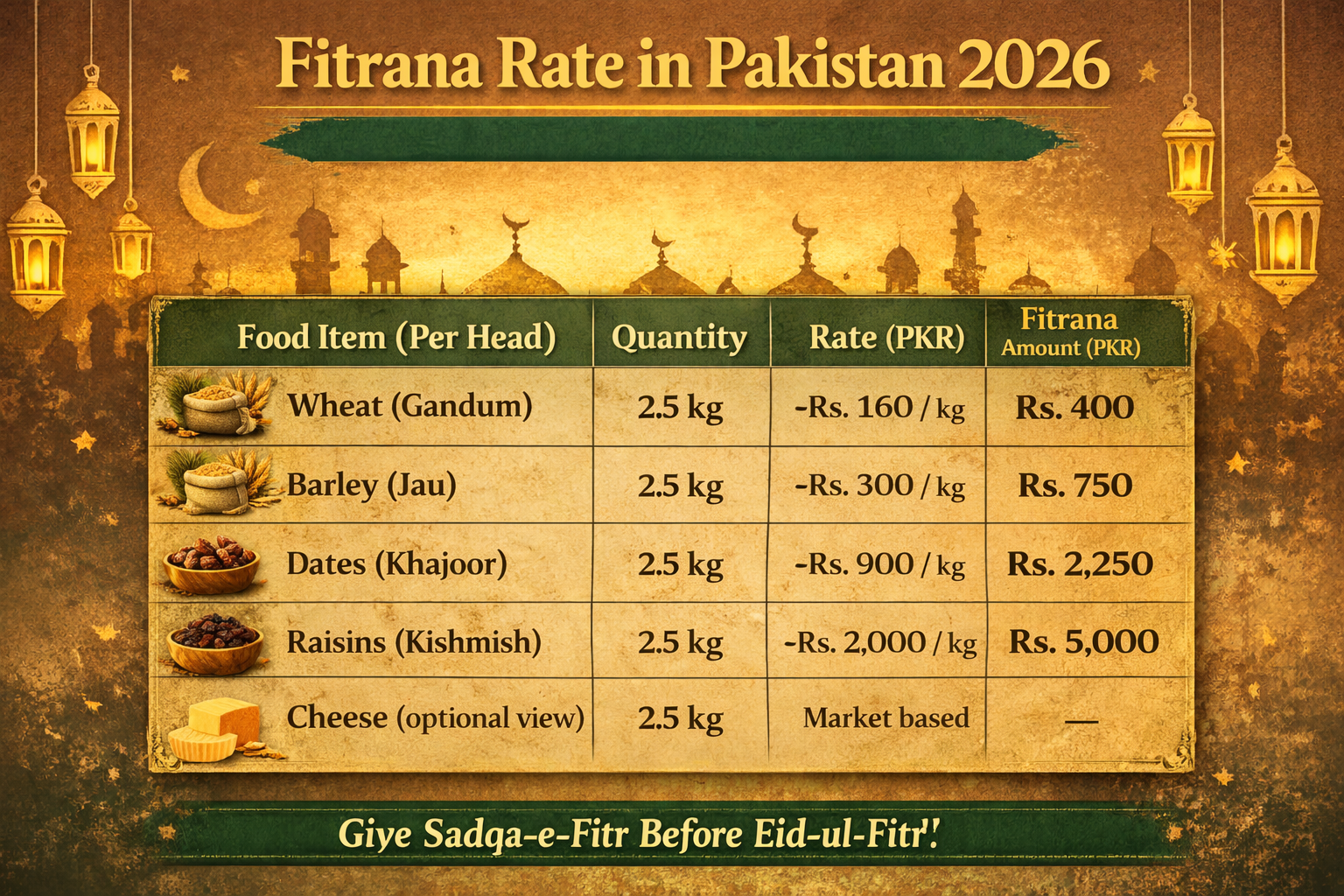
| Food Item (Per Head) | Quantity | Rate (PKR) | Fitrana Amount (PKR) |
|---|---|---|---|
| Wheat (Gandum) | 2.5 kg | Rs. 160 / kg | Rs. 400 |
| Barley (Jau) | 2.5 kg | Rs. 300 / kg | Rs. 750 |
| Dates (Khajoor) | 2.5 kg | Rs. 900 / kg | Rs. 2,250 |
| Raisins (Kishmish) | 2.5 kg | Rs. 2,000 / kg | Rs. 5,000 |
| Cheese (optional view) | 2.5 kg | Market based | — |
As the holy month of Ramadan approaches, Muslims across Pakistan prepare not only for fasting and prayer but also for the charitable obligations that purify their wealth and soul. Among these obligations is Sadqa e Fitr (often called Fitrana), a compulsory charitable donation that must be paid before the Eid al-Fitr prayers.
The correct rates for Fitrana and Fidya is crucial for every household head. These contributions ensure that the less fortunate can also celebrate Eid with dignity and joy. However, with fluctuating food prices, the rates change annually based on the market value of staple food items.
This guide details the estimated Fitrana rates in Pakistan for 2026, explains the difference between Fitrana, Fidya, and Kaffarah, and helps you calculate exactly what you owe based on your financial capacity.
Fidyah, Kaffarah, and Fitrana
Before diving into the specific rates for 2026, it is important to distinguish between the three main types of Ramadan-related financial obligations. While they all serve as forms of charity, their conditions and applicability differ.
What is Fitrana (Sadqa e Fitr)?
Fitrana constitutes a charitable donation that every Muslim who possesses food in excess of their needs must pay before the Eid prayer. It is obligatory on every member of the household, including children and the elderly. The head of the household usually pays on behalf of their dependents. Its purpose is twofold: to purify the person who fasted from any indecent act or speech and to help the poor and needy.
What is Fidya?
Fidya is a compensation paid by those who cannot fast during Ramadan due to a valid reason such as extreme old age, chronic illness, or pregnancy/breastfeeding (if fasting poses a health risk) and cannot make up the missed fasts later. Fidya is essentially paying to feed a needy person for every day of fasting missed.
What is Kaffarah?
Kaffarah is the penalty for intentionally breaking a fast without a valid excuse. The penalty is much steeper than Fidya. Typically, Kaffarah involves feeding 60 needy people for every broken fast or fasting for 60 consecutive days.
Fitrana Rate 2026 Pakistan Per Head
The rate of Fitrana is calculated based on the market price of approximately 2.25 kg of staple food items like wheat, barley, dates, or raisins. Religious scholars generally set a minimum amount based on wheat, but those with higher incomes are strongly encouraged to pay according to the value of more expensive items like dates or raisins to maximize the benefit to the poor.
While official rates are usually announced by the Ruet-e-Hilal Committee closer to Eid, estimates based on projected 2026 commodity prices are listed below.
Wheat (Gandum)
For the majority of households, the wheat rate is the baseline.
- Per Head: ~Rs 220 to 400
Barley (Jau)
Barley is the next tier up and was a common staple during the time of the Prophet (PBUH).
- Per Head: ~Rs 450
Dates (Khajoor)
Dates hold significant religious value and are a higher tier of donation.
- Per Head: ~Rs 1,650
Raisins (Kishmish)
Raisins represent a premium tier of Fitrana.
- Per Head: ~Rs 2,500
Ajwa Dates
For the affluent who wish to give generously, calculating based on Ajwa dates provides substantial support to the needy.
- Per Head: ~Rs 14,700
Note: These figures are estimates based on market trends. It is always recommended to check the verified rates announced by local mosques or religious authorities in your specific city (e.g., Karachi, Lahore, Islamabad) during the last ten days of Ramadan.
Fidya Rates for Ramadan 2026
If you are unable to fast due to permanent health issues or old age, you must pay Fidya. This amount is calculated per fast missed. If you miss the entire month (30 days), the total amount accumulates accordingly.
Here is the breakdown of Fidya for 2026:
Wheat (Gandum) Basis
- Per Day: Rs 220 to 400
- For 30 Days: Rs 6,600
Barley (Jau) Basis
- Per Day: Rs 450
- For 30 Days: Rs 13,500
Dates (Khajoor) Basis
- Per Day: Rs 1,650
- For 30 Days: Rs 49,500
Raisins (Kishmish) Basis
- Per Day: Rs 2,500
- For 30 Days: Rs 75,000
Ajwa Dates Basis
- Per Day: Rs 14,700
- For 30 Days: Rs 441,000
Who is Eligible to Receive Fitrana?
The recipients of Fitrana are generally the same as those eligible for Zakat. This ensures that the charity reaches the most vulnerable segments of society. Eligible recipients include:
- The Poor (Al-Fuqara): Individuals who lack the wealth to meet their basic needs.
- The Needy (Al-Masakin): Those in dire poverty or destitution.
- Debt-Ridden: Individuals overwhelmed by debt and unable to pay it off.
- Wayfarers: Travelers who are cut off from their resources and need assistance to return home.
It is often recommended to look for deserving people within your own extended family or neighborhood first. If none are found, reputable charities that specialize in food distribution are excellent alternatives.
How to Calculate Your Household Fitrana
Calculating your total Fitrana is a simple process. Follow these steps:
- Count your dependents: Include yourself, your spouse, children (even newborns born before the Eid prayer), and any other dependents living in your home.
- Choose your tier: Assess your financial situation.
- If you are low-income or middle-income, you may choose the Wheat rate (Rs 220).
- If you are upper-middle class, consider the Barley (Rs 450) or Dates (Rs 1,650) rate.
- If you are wealthy, it is highly meritorious to pay the Raisins (Rs 2,500) or Ajwa (Rs 14,700) rate.
- Multiply: Multiply the number of people by the rate you selected.
Example Calculation:
A family of 5 (Husband, Wife, 3 Children) decides to pay based on the Dates rate.
- Rate: Rs 1,650
- Family Members: 5
- Calculation: 1,650 x 5 = Rs 8,250
Giving Zakat-al-Fitr Online
In the digital age, ensuring your charity reaches the right people has become easier. Many trustworthy organizations in Pakistan accept Fitrana online. When paying online, ensure you do so a few days before Eid to allow the organization time to convert your money into food and distribute it before the Eid prayer.
When donating online:
- Look for organizations that specify a “Fitrana” or “Zakat-al-Fitr” fund.
- Verify their credibility and track record.
- Calculate the transaction fees to ensure the full required amount reaches the beneficiary.
Frequently Asked Questions
When should Fitrana be paid?
Fitrana becomes obligatory from the sunset of the last day of Ramadan and must be paid before the Eid al-Fitr prayer. However, scholars agree that it can be paid earlier in Ramadan to ensure it reaches the needy in time for them to buy clothes and food for Eid.
Is Fitrana compulsory on a newborn baby?
Yes, if a child is born before the Eid prayer, the head of the household must pay Fitrana on their behalf. If the baby is born after the Eid prayer, Fitrana is not obligatory for them for that year.
Can I give Fitrana to my parents or children?
No, you cannot give Fitrana (or Zakat) to your direct ascendants (parents, grandparents) or direct descendants (children, grandchildren). You are already obligated to support them financially if they are in need. It should be given to other relatives or unrelated needy people.
What happens if I forget to pay before Eid prayer?
If you miss the timing, the obligation does not disappear. You must still pay it as Sadaqah (general charity), but you will have missed the specific reward and virtue of paying it as Zakat-al-Fitr on time. It is sinful to delay it without a valid excuse.
Do I pay based on my diet or my wealth?
While the text mentions staple foods, the spirit of the law implies financial capacity. If you regularly consume high-quality meat and fruits, paying the wheat rate (the absolute minimum) is technically permissible but discouraged. You should pay according to your lifestyle standard.
Embracing the Spirit of Giving
As we approach Ramadan 2026, let us remember that Fitrana is not just a tax or a fee. It is a beautiful mechanism of social welfare that connects the rich with the poor. It ensures that when the sun rises on the day of Eid, no plate is empty, and no child is without joy.
By calculating your Fitrana correctly and paying it generously perhaps opting for the date or raisin rate if you can afford it you purify your own fasting and uplift your community. May your fasting, prayers, and charity be accepted.